
 The latest entry in our Discworld marathon has been examined not just by Tom but Glen as well, for a joint look at Pratchett’s war of the sexes, the third discworld novel Equal Rites:
Glen: I’m a big fan of Pratchett, though my love for the Discworld has lessened with some of the newer novels. He’s a unique author and incredibly versatile. I’m currently listening to the Long Mars as an audio book, a completely different style to Discworld.
I flew back from Kentucky yesterday (thanks giving trip), it was a nine hour journey and I needed something to get me through. Terry Pratchett was that something. His writing is a warm, comfortable jumper I’ll that always return to. His books are still as funny when I picked them up as a 13 year old in our school library, though I’m now able to appreciate significantly more subtext…
I read both Equal Rites and the Fifth Elephant on the plane. In some ways they felt like two different authors to me. That made me take a long, hard look through the bibliography at the front of the book. I came to realise I’d moved beyond favourite character threads (Vimes vs. Rincewind, or Granny vs. Lipwig) as I was used. I’d passed through the looking glass.
Tom’s Perspective: Equal Rites offers a lot more meat than either of its predecessors, although that mostly comes in the form of Granny Weatherwax. By giving us a selection of main characters who actually respond and get involved with the story as opposed to just passing through it Pratchett gets to explore some far more interesting narrative terrains, although the ending boils down to roughly the same conclusion as the Light Fantastic.
Short, sweet, just the right length to engage and amuse without overstaying it’s welcome this was the perfect, mature, response to the anarchy of the first two novels.
 By which I mean do you consider yourself as a physical entity, as a mobile collection of limbs and organs that can move and think and communicate with like-minded individuals? Or is there an inner you, a ‘soul’ if you will, that just uses your body simply for transport and stimulation? Are both viewpoints equally true?
 The Discworld is a place that follows archetypal fantasy but does so through the lens of cynicism and wit. It’s scope comes through a little clearer here than in it’s predecessor the Colour of Magic. Rather than riffing off high fantasy books with warrior maidens, gambling gods and nameless horrors it offers a cottage made of sweets, an aged Conan the Barbarian and a political struggle within the halls of wizardry as the wizard Trymon plots his way to the top. The set pieces (because like it’s predecessor the plot is little more than a loose movement from one moment to the next) are much shorter and snappier, resulting in much better flow. Perhaps the most significant improvement in this book is that it has more than two real characters.
 Imagine you are a 2-dimensional shape living in a 2-dimensional universe that consists purely of squares and rectangles of various sizes. You can move freely around this plane, subject to an equivalent to gravity, and somehow communicate with other sentient rectangles. What would you do? What would you say? How would you tell a story?
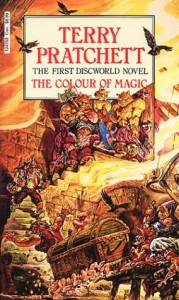 vered the Discworld in the form of a graphic novel; an excellent adaptation which brings an extraordinary level of light and colour to the vivid world Pratchett has concieved. As a comic strip the adventures of Rincewind and Twoflower feels episodic in nature, the pair moving from one adventure to the next, and the format of the story flows most naturally here. Many years later came the television adaptation starring David Jason and Sean Astin, which offers an entirely different take on the two characters, turning them into an elderly innofensive bumbler and an american style tourist. Enjoying that I returned to the source material with an abridged audiobook read by Tony Robinson, who invests such wit and life into the characters his voice feels like the definitive voice of the series. But when, some months later still, I finally decided to read the original book, I found that there was yet more to discover. As good as the audio books are they are heavily abridged. Each iteration of this story contains something the other’s don’t and I’d struggle to call the original book the definitive take, as despite containing the most material it also shows just how far the author has come as a writer in it’s inherent weaknesses.